Reclaiming safety in the age of surveillance. Identity-free is the key.
No phone numbers. No emails. No central accounts. Your privacy is not a setting. It is the architecture.
Even “secure” apps know who you are.
Every messaging app you have been told to trust still asks for a phone number. That number is a permanent link between your digital life and your real-world identity. Your messages may be encrypted. Your identity is not.
WhatsApp was fined for failing to disclose how it shares your identity data with its parent advertising company. Your suspicion was justified.
The encryption held. The identity did not.
Look closely at how people actually get caught, targeted, or exposed. The cipher is rarely the failure. The real-world identity every other app insists on is.
An entire encrypted network, quietly run by the FBI.
Operation Trojan Shield handed out phones on a locked-down messaging app. The encryption never broke. The identities and the metadata around them did, and that was enough to make arrests across more than a dozen countries.
Strong encryption, one wrong contact on the roster.
A senior official added the wrong to a phone-number-based group chat. The cipher held perfectly. Sensitive operational planning still landed in front of someone who should never have seen it.
Soldiers located without breaking a single message.
Frontline troops were tracked not by cracking encryption, but by matching persistent phone numbers to patterns of behavior on a mainstream secure app. The number was the beacon.
Deanonymized by the identifiers their app carried.
Demonstrators were identified through device and account identifiers leaking quietly in the background. They were careful with what they said. The app was not careful with who they were.
In none of these did the math fail. The identity did. The only real fix is to stop being a target at all.
We remove the who from the what.
If no one knows who you are, there is nothing for anyone to share, sell, or lose. Not even us. Here is how that compares to the app you use today.
Built for high-risk threat models.
Privacy here is not a promise we ask you to trust. It is a set of structural decisions that make collecting your identity technically impossible.
Combinatorial security
Someone drops a message into your one-way mailbox, but only you hold the key. That message is shattered into a random number of shards of varying size, each sealed with its own one-off transform, then scattered through haystacks of decoy data on servers worldwide. Nothing ever travels as a single, interceptable object.
Reaching each shard means traversing real directory structure. That time cannot be skipped, not even by a quantum computer.
A correctly cracked shard still reads as pure noise, so an attacker never knows whether they have actually won.
Identity-free architecture
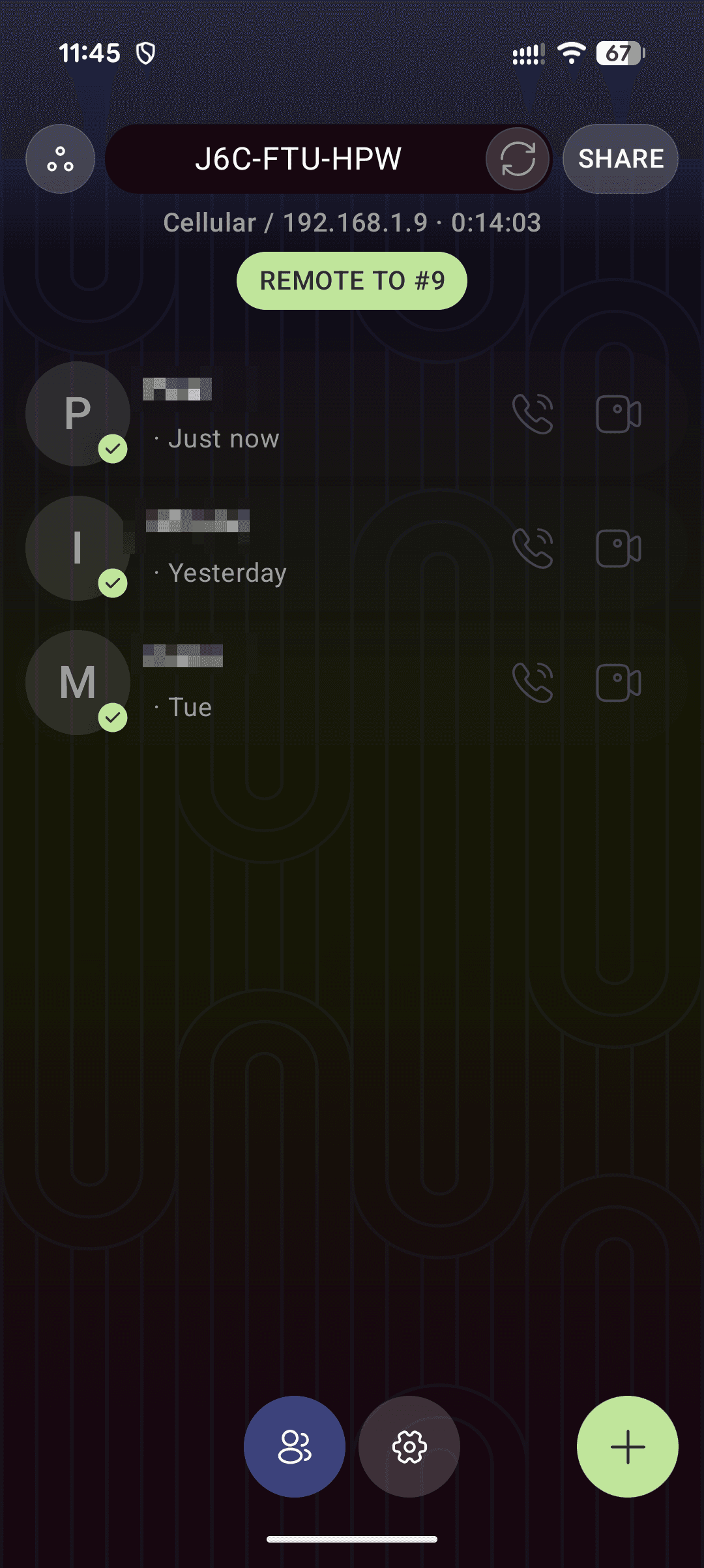
No registration. No account. Your identity is a random string tied only to your physical device. Delete the app and it vanishes for good.
It works like a handwritten address book kept only on your phone. Only people you explicitly add can reach you, and nothing lives on a server.
Quantum secure
Sharding sidesteps the harvest-now, decrypt-later threat. Even with unlimited computing power, an attacker cannot reassemble the pieces in the correct order.
And if they somehow could, they would still need the recipient's private key, which never leaves the device. There is nothing to solve.
Panic PIN
A silent duress code. Entering your Panic PIN triggers a hardware-secured wipe of every local key and message. To anyone watching it looks like an ordinary failed login, but everything is already gone.
Enter any 4 digits to unlock. Try the panic code 0000 to see what an adversary would.
Built for when the device is the threat.
Coercion, seizure, and a phone in the wrong hands are part of the model, not an afterthought.
Burn on read
Messages can self-destruct the instant they are opened. The history is gone before a device can be taken.
Proof of life
Five device sensors confirm a real person is holding the phone, so emulators and automated bots see nothing.
Ephemeral by default
Shards and notifications evaporate from every haystack and from your device within 24 hours, often sooner.
Forward secrecy
Keys rotate with every single message. Compromise one and you learn nothing about the messages around it.
Thirteen years in the making.
prvc is not a weekend startup or a pivot. It is the life’s work of one researcher who decided, more than a decade ago, that the real flaw in private messaging was never the encryption. It was being asked who you are.

crpt.info, the anti-email
The first working system: secure, ephemeral messaging that refused to behave like email. The idea that identity itself was the vulnerability started here.
The research into combinatorial security
More than a decade spent on two ideas that compound: time you cannot rush, and entropy you cannot read. Privacy treated as a math problem, not a marketing one.
US Patent 11,516,192
System and Method for Combinatorial Security, awarded and on the public record. You can read the patent in full.
prvc.app
The whole architecture, refined into something that fits in your pocket and asks nothing of you. No number, no account, no trace.
Common questions.
Still unsure about something? Write to support@prvc.app and a person will answer.
Our zero-data mandate. Collection is technically impossible.
This is not a policy we promise to honor. It is the only outcome the architecture allows.
What we never collect
Updated 18 Mar 2026Simple terms
Updated 18 Mar 2026Stop being the product. Become unfindable.
No phone number. No account. No trace. Download prvc and your privacy stops being a setting you hope works.
Free. No account needed, ever.Talk to a person
Write to support@prvc.app. A real person replies within 48 hours, and in real time during app review.
Delete your data
Delete the app and every local trace is wiped at once. There is no central account to close and nothing on our side to erase.